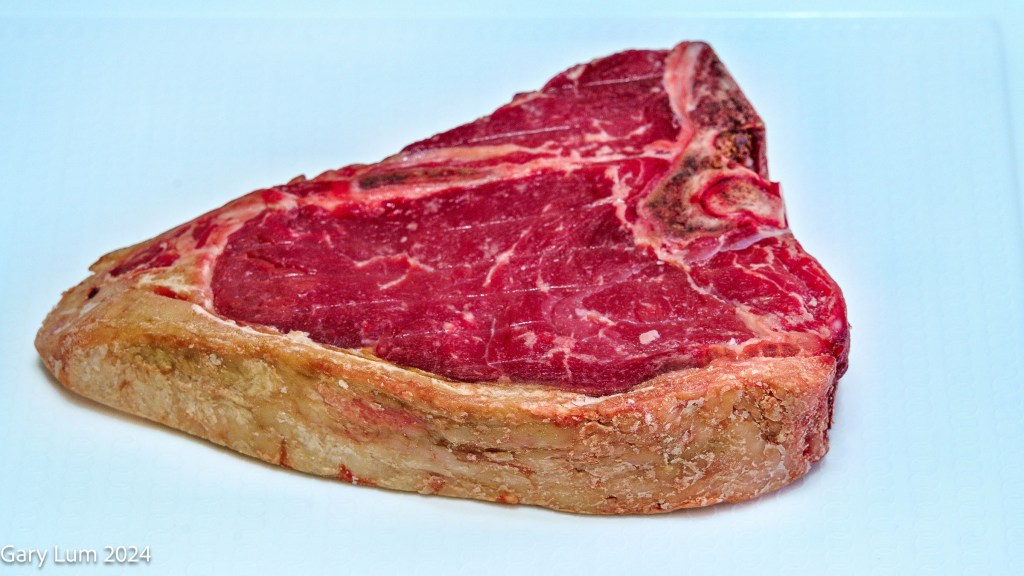
The T-bone steak is a premium cut of beef that comes from the front section of the short loin on a steer’s middle back. It has a strip of the top loin and a chunk of tenderloin. A T-shaped bone from the lumbar spine separates these two pieces. The T-bone combines the meaty flavour of a strip steak, often called a New York strip when sold on its own, with the tenderness of the filet mignon.
In the British Commonwealth countries (formerly the dominions of the British Empire), the strip side of the T-bone is known as the porterhouse, while the tenderloin section is known as the fillet. It is also referred to as a T-Bone steak in the US and Canada.
T-bone steak is known for its flavourful characteristics. It is quicker to cook than a tomahawk cut. Searing at high temperatures creates a caramelised, juicy steak.
The T-bone is made for grilling. Bits of fat keep it moist, while the tenderloin heart stays tender and flavourful. The intact bone provides a sturdy handle for grabbing the steak and flipping it without puncturing the meat and losing juice. Another method is to pan-sear the steak and then finish cooking it in the oven.
Nutrient Values An 85-gram serving of cooked T-bone steak provides:
- Calories: 246
- Total Fat: 17 g
- Saturated Fat: 7.1 g
- Trans Fat: 1.1 g
- Polyunsaturated Fat: 0.8 g
- Monounsaturated Fat: 7.8 g
- Cholesterol: 71 mg
- Sodium: 53 mg
- Total Carbohydrates: 0 g
- Protein: 21 g
- Vitamin D: 0.1 µg
- Calcium: 16 mg
- Iron: 2.8 mg
- Potassium: 210.8 mg
T-bone steak is a source of protein for building and repairing tissues, producing hormones, and supporting the immune system. It is also a source of iron, for red blood corpuscle production and oxygen transport. T-bone steak has zinc, contributing to immunological function, wound healing, and cell growth. It is also a source of vitamin B12, to produce red blood corpuscles and the functioning of the nervous system.
Ingredients
Equipment
- Frypan
Instructions
- Unwrap the meat and place it on a rack uncovered in the refrigerator overnight.
- Heat a frypan.
- Cook the steak by flipping it every 30 seconds until the meat is done.
- Rest the meat on a board for 5 minutes.
- Slice the meat, season with flaky salt, and enjoy.
Photographs


Dominions of the British Empire
The term “dominion” was used to describe several largely self-governing countries within the British Empire. The progression from colonies to dominions saw an uneven increase in degrees of colonial self-governance from the late 19th century through the 1930s.
The dominions were:
- Canada
- Australia
- New Zealand
- Newfoundland
- South Africa
- Irish Free State
These dominions were accorded “Dominion status” at the 1926 Imperial Conference through the Balfour Declaration of 1926. This declaration recognised Great Britain and the Dominions as “autonomous communities within the British Empire, equal in status, in no way subordinate one to another in any aspect of their domestic or external affairs, though united by a common allegiance to the Crown and freely associated as members of the British Commonwealth of Nations”.
Their full legislative independence was subsequently confirmed in the 1931 Statute of Westminster. In the 1920s and 1930s, they began to represent themselves in international bodies, in treaty making, and in foreign capitals. Later, India, Pakistan, and Ceylon (now Sri Lanka) also became dominions for short periods.
With the transition of the British Empire into the Commonwealth of Nations after World War II, it was decided that the term “Commonwealth country” should formally replace “dominion” for official Commonwealth usage. This decision was made during the 1949 Commonwealth Prime Ministers’ Conference when India was intending to become a republic, so that both types of governments could become and remain full members of the Commonwealth. After this, the term “dominion”, without its legal dimension, stayed in use for thirty more years for those Commonwealth countries which had the crown as head of state.



Ask a question or make a comment