
Pork rashers, commonly sold in Australia, are thin slices of pork belly. They are known for their flavour and tender texture, making them a popular choice for various cooking methods. Pork rashers are typically cut from the pork belly, a fatty and flavourful part of the pig. They may be cooked on barbecues, roasted, or slowly cooked to achieve a crispy exterior and tender interior.
Cooking and Eating Characteristics
Pork rashers have a distinctive appearance and taste:
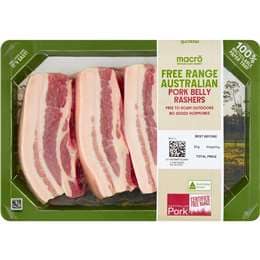
- Appearance: Rectangular slices, approximately 1 cm thick, with pink-coloured meat and visible fat marbling.
- Taste and Texture: They develop a crispy, crunchy exterior when cooked, with a tender and succulent interior.
Preferred Cooking Techniques
To optimise the texture and flavour of pork rashers, the following cooking techniques are preferred:
- Pan-frying: Fry in a skillet over medium-high heat for 2–3 minutes per side. This method results in a caramelised exterior.
- Grilling: Preheat a grill to medium-high heat and cook the rashers for 4–5 minutes per side. This imparts a smoky, charred flavour.
- Baking: Place in a 200 °C oven for 15–20 minutes, flipping halfway through. This method is convenient and results in evenly cooked rashers.
For a 100 g serving of pork rashers:
- Energy: 244 kcal
- Protein: 19.4 g
- Fat: 18.6 g
- Saturated Fat: 7.29 g
- Carbohydrates: 0 g
Reasons Some People Dislike Pork Rashers
Some people may not like pork rashers due to:
- High Fat Content: The fatty nature of pork rashers may be unappealing to those who prefer leaner cuts of meat.
- Texture: The combination of crispy exterior and tender interior may not be preferred by everyone.
- Dietary Restrictions: Individuals following certain dietary restrictions, such as vegetarian, vegan, or religious dietary laws, may avoid pork rashers.
- Parasites: As a boy in the 1960s and 1970s in Brisbane, pork had a bad reputation. In the first half of the twentieth century, animal husbandry and food safety practices didn’t always guarantee parasite-free pork. These days, pork bought in supermarkets can be assumed to be parasite-free.
Ingredients
- Pork rashers
Equipment
- Frypan
Instructions
- Unwrap the pork rashers.
- Dry the surface of the meat with absorbent paper or a towel.
- Heat the frypan and cook the pork rashers, flipping every 30 seconds until the surface is caramelised.
- Serve on a plate and eat with your fingers or chopsticks or a knife and fork.
Photographs


Bibliography
- Calories in Woolworths Pork Rashers and Nutrition Facts
- What Are Pork Rashers? A Complete Guide to the Crispy, Savory Breakfast …
- pork rashers Calories and Nutritional Information – FatSecret
- Sticky glazed pork rashers – Australian Pork
- American pork rashers | Women’s Weekly Food – Australian Women’s Weekly …
- Sticky sweet pork rashers with rice | Women’s Weekly Food
- Sticky Pork Rashers with Maple Bourbon BBQ Sauce
- THE BEST PORK BELLY RASHERS – SWEET + STICKY BY PHOODIE
- Pork Rashers: Unraveling The Delicious Mystery Behind This Sizzling …
- What Are Pork Rashers? An Expert’s Guide – VeryMeaty
- What are Rashers? (with pictures) – Delighted Cooking
- STICKY GLAZED PORK RASHERS – Food Lovers Recipes
- Pork Meat Composition and Health: A Review of the Evidence – MDPI
- Meat consumption and risk of 25 common conditions: outcome-wide …
- Consumption of Pork by Australians A Secondary Analysis of the 2011 …
- https://doi.org/10.3390/foods13121905



Ask a question or make a comment