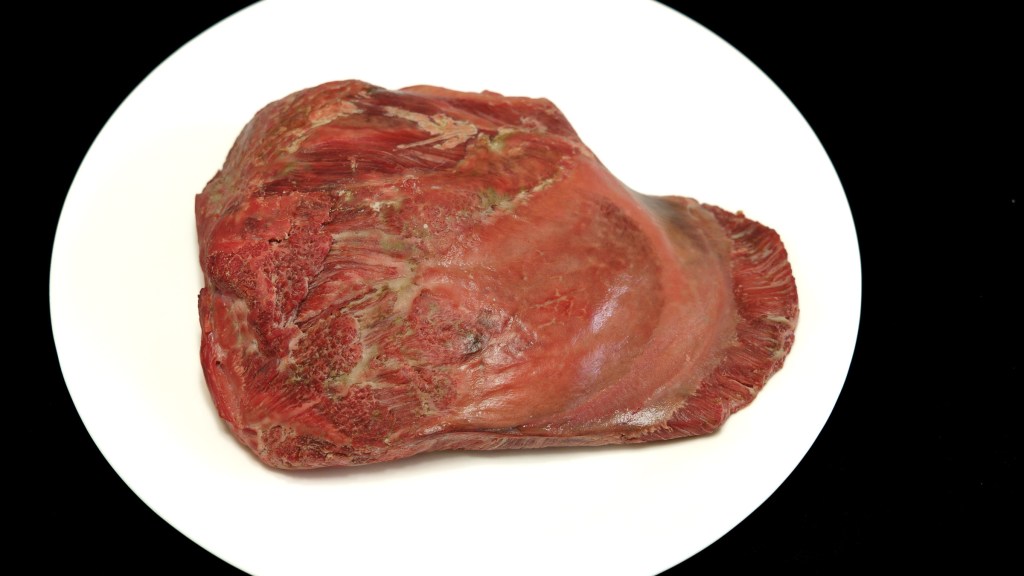
My regular supermarket doesn’t stock beef cheeks, nor does the butcher I visit.
I was in another supermarket chain during the week and saw a large beef cheek and purchased it. This particular beef cheek is allegedly from a Wagyu beast.
Beef cheeks are a cut of beef taken from a cow’s facial cheek muscles. These muscles are heavily used as the cow chews, making them rich in connective tissue and collagen. When cooked slowly, this connective tissue breaks down into gelatine, resulting in tender, flavourful meat.
Names in Other Countries
United States: Often referred to as “cheek meat” or “veal cheeks”.
United Kingdom: Sometimes called “ox cheeks”.
Mexico: Known as “barbacoa de cachete” when used in traditional dishes.
Anatomy of Beef Cheeks in a Bovine
Beef cheeks are located in the facial area, extending from the jaw to the shoulder. They consist of the masseter muscle, which is responsible for chewing, and are surrounded by a significant amount of connective tissue and collagen.
Cooking and Eating Characteristics
Beef cheeks are known for their rich, beefy flavour and tender texture when cooked properly. They are best suited for slow-cooking methods such as braising and slow roasting, which allow the tough connective tissues to break down into gelatine.
Preferred Cooking Techniques
- Braising: Cooking the beef cheeks slowly in a covered pot with a small amount of liquid.
- Slow Roasting: Cooking at a low temperature for an extended period.
- Stewing: Combining with vegetables and other ingredients in a liquid and simmering slowly.
Nutrient Values
| Nutrient | Amount per 100g |
| Energy | 250 kcal |
| Protein | 26 g |
| Fat | 15 g |
| Carbohydrates | 0 g |
Reasons Some People Do Not Like Beef Cheeks
Texture: Some people find the texture unappealing when not cooked properly.
Appearance: The cut may look unattractive to those unfamiliar with it.
Preparation Time: Slow-cooking methods require significant time and effort.
Do you enjoy cooking beef cheeks, or are you considering trying them for the first time?
Recipe
Ingredients
Australian Wagyu beef cheek — $AUD14.89 at $AUD22.00/kg
Beef short ribs — for added beef flavour — $AUD21.63 at $AUD25.00/kg
Salt to taste
Beef broth — homemade from cooking a beef brisket
Instructions
Prepare the Beef Cheek:
Trim any excess fat and sinew from the beef cheek.
Season the beef cheek generously with salt and pepper on both sides.
Sear the Beef Cheek:
Heat butter in a large heavy-bottomed pot or Dutch oven over medium-high heat.
Sear the beef cheek on all sides until it is browned and has a nice crust, about 3–4 minutes per side.
Remove the beef cheek from the pot and set them aside.
Deglaze and Add Liquid:
Pour in water, scraping the bottom of the pot to release the fond.
Return the Beef Cheek:
Add the seared beef cheek and beef short ribs back to the pot, along with the beef broth.
Slow Cook the Beef Cheek:
Cover the pot with a lid and let the beef cheek cook slowly over low heat for 5–6 hours, or until they are fork-tender.
Serve:
Remove the beef cheek from the pot and place it on a dinner plate.
Set aside the beef short ribs for another meal.
Sieve the cooking liquor and refrigerate as beef broth.
Photographs
Here is a gallery of photographs. Click on an image and scroll through them.


Thoughts on the beef cheek
The meat is delicious. Beefy flavour and tender enough to eat with a spoon and fork.


Ask a question or make a comment